You found the pool contractor. You signed the contract. The excavator is showing up in three weeks. And somewhere in between choosing tile and picking a filter system, someone asked you: ‘So what are you doing for the deck?’
For most homeowners, pool deck installation is an afterthought — a practical necessity that gets budgeted last, researched least, and almost always regretted most. That is a mistake, and this article is designed to fix it.
We have installed pool decks for homeowners across the greater Cincinnati region for years. What follows is the knowledge that separates a pool deck that holds up beautifully for 30 years from one that shifts, stains, cracks, and demands constant repairs. Most of it never comes up in a contractor sales conversation.
The Problem With How Most Pool Decks Are Built
Here is the honest truth about the residential pool deck market: most of them are not built to a meaningful engineering standard. They are built to a price point.
A homeowner gets a new pool installed, then hires the cheapest patio contractor they can find to pour a standard concrete apron around it. Two winters later, a corner lifts. Three years in, there are control joint cracks. Five years in, the whole thing is a patchwork of mismatched repairs.
This is not inevitable. It is the result of skipping steps — specifically, the base preparation steps that are invisible once the surface material is installed and that therefore never get included in competitive low bids.
The most expensive part of a pool deck is what you never see. The base material, compaction depth, drainage slope, and expansion joint placement determine whether the surface holds up or fails — and none of those things are visible once the job is done.
Material Selection: There Are More Options Than You Think
Most homeowners are presented with two choices: concrete or pavers. In reality, there are at least five distinct material categories for pool deck installation, each with meaningfully different performance characteristics.
1. Concrete Pavers
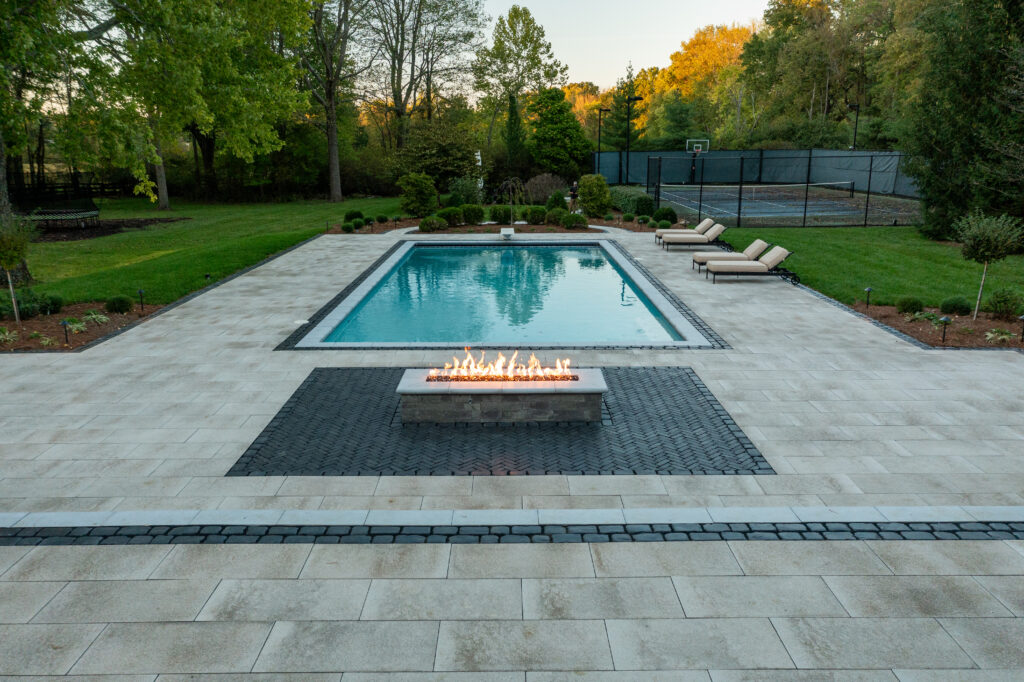
The most common choice for residential pool decks, and for good reason. Manufactured concrete pavers are dimensionally consistent, available in hundreds of colors and profiles, and — critically for pool environments — individually replaceable if a section is ever damaged. When a utility contractor needs to access a buried line and cuts through a paver deck, you simply re-lay the section. With poured concrete or natural stone mortared in place, a utility cut becomes a permanent scar.
The key variable with pavers is the base system. An improperly compacted base — even under premium pavers — will shift and heave in Ohio’s freeze-thaw cycles. ICPI (Interlocking Concrete Pavement Institute) installation standards call for a minimum 6-inch compacted aggregate base on residential applications, with depth increasing based on soil type and load requirements. On sites with expansive clay soils (common in southwestern Ohio), we routinely excavate deeper and add a geotextile separation layer to prevent subgrade migration into the base aggregate.
2. Natural Bluestone
Pennsylvania bluestone is one of the most durable natural materials available for outdoor hardscape. Its distinctive blue-gray coloration and cleft surface texture are difficult to replicate with manufactured products, and its slip resistance — even when wet — is excellent. For homeowners who prioritize aesthetics and long-term material quality, a bluestone pool deck represents a genuine investment.
The installation method matters enormously with natural stone. A dry-set installation over a compacted aggregate base allows for differential movement and easy repair. A mortared installation over a concrete slab looks slightly cleaner initially but is far more vulnerable to cracking as the substrate moves. In climates with significant freeze-thaw cycles like Ohio’s, we default to dry-set natural stone unless there is a specific architectural reason to mortar.
3. Travertine
Travertine has become increasingly popular for pool deck installation in the last decade, and it is worth understanding why. Travertine’s natural porosity makes it one of the coolest materials available underfoot in direct sunlight — a significant practical advantage for a surface that pool users walk on barefoot. It is also available in large-format tiles that create a clean, contemporary aesthetic.
The caveat: travertine requires specific sealant maintenance to prevent staining from pool chemicals and organic debris. It is also more brittle than concrete pavers at thin profiles, so proper base preparation and a minimum 3/4-inch material thickness are essential for long-term performance.
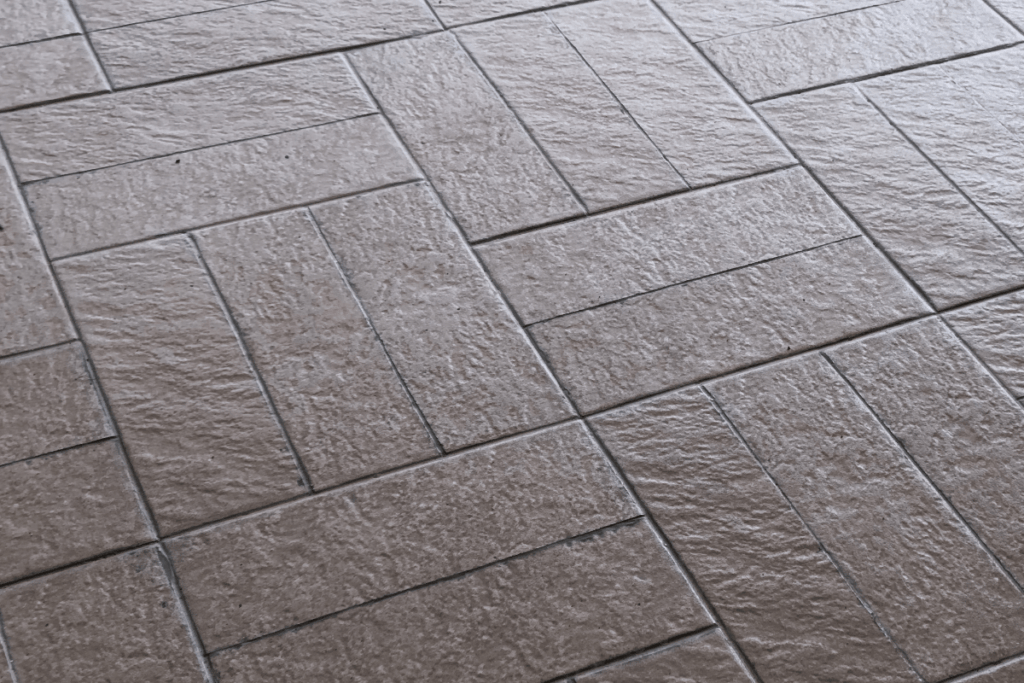
4. Stamped Concrete
Stamped concrete remains popular because of its relatively low initial cost and the wide variety of patterns available. In full fairness: a well-installed stamped concrete deck can look excellent for a decade or more with proper sealing and maintenance.
The honest disadvantage is repairability. Once a stamped concrete slab cracks — and all concrete eventually cracks — a seamless repair that matches the original pattern, texture, and color is effectively impossible. This is why many homeowners who choose stamped concrete eventually budget for a full overlay or replacement rather than living with visible repairs.
If you are comparing bids between paver installation and stamped concrete and the stamped concrete quote is significantly lower, make sure you are comparing total lifetime cost — including the near-certainty of eventual overlay or replacement — not just initial installation cost.
5. Porcelain Tile
Large-format porcelain tile has entered the residential pool deck market in the last five years, and for homeowners pursuing a specific contemporary aesthetic, it is worth a serious look. Modern porcelain paver products — typically 24×24 or 24×48 inches — offer extremely low water absorption rates, excellent stain resistance, and consistent coloration across the surface.
The installation complexity is high. Large-format porcelain requires a perfectly flat, stable substrate with minimal deflection tolerance. It is also among the most difficult materials to cut on-site without specialized equipment. For the right project with the right budget and the right installer, the result can be spectacular. For budget-driven installations or sites with variable subgrades, the failure risk is significant.
Drainage: The Variable Every Homeowner Ignores
Pool deck drainage is one of the most misunderstood aspects of pool hardscape, and mistakes here cause more long-term problems than almost any other design or installation error.
The deck surface must slope away from the pool at a minimum of 1/4 inch per foot — enough to move water off the surface efficiently without creating a visible tilt that feels uncomfortable to walk on. This sounds simple, but executing it precisely across a large irregular deck perimeter, with transitions to landscaping, lawn, and existing hardscape, requires careful planning and precise grading during installation.
Beyond the surface slope, consider where the water goes after it leaves the deck. In many residential installations, the deck drainage simply flows onto adjacent lawn areas — which is fine in modest rainfall events but can cause significant erosion and saturation problems during heavy rain. A more sophisticated approach involves channel drain installation at the perimeter of the deck, collecting and routing water to a defined outlet or infiltration area away from the pool structure and the home’s foundation.
Pool chemical splash and backwash discharge add complexity. The water leaving a pool deck contains chlorine, pH-adjusting chemicals, and other treatment compounds. In many Ohio municipalities, this water cannot be directed into storm drains or waterways without treatment. Understanding your local discharge regulations before finalizing your drainage design can save significant headaches later.
On properties with existing drainage problems — standing water, erosion, saturated soil — pool deck installation should never proceed without first resolving the underlying drainage issues. Adding impervious surface to a site that already struggles to manage water will make existing problems dramatically worse.
Expansion Joints: The Detail That Prevents Thousands in Repairs
Whether your pool deck is concrete, natural stone, or poured in any form, thermal expansion and contraction are constant forces acting on the surface. Ohio’s temperature range — from sub-zero nights in January to 95°F afternoons in August — creates significant differential movement in hardscape materials.
Without properly placed and properly detailed expansion joints, that movement eventually expresses itself as cracking. The cracking itself is not always structurally significant, but it is visually prominent and allows water infiltration that accelerates freeze-thaw damage.
Properly designed expansion joints are placed at intervals that correspond to the material, slab thickness, and temperature exposure of the specific installation. For concrete slabs around pools, this typically means one control joint every 8-10 feet in each direction, with the joint width and filler material selected based on the anticipated movement range.
Here is the key detail that most homeowners do not know: a gap left open or filled with sand is not an expansion joint. It is an open crack. True expansion joint material — polyurethane caulk, backer rod, or purpose-made joint filler — must be flexible enough to compress and expand with the adjacent material through its full temperature range. When contractors skip this detail or substitute inappropriate materials to save time, the consequences appear two or three winters later.
Pool Coping: Where the Deck Meets the Water
Pool coping — the cap material that sits at the edge of the pool shell and forms the transition between the water surface and the deck — is a detail that significantly affects both the aesthetics and the long-term performance of the entire installation.
Coping must accommodate the thermal movement of both the pool shell (which expands and contracts independently) and the surrounding deck. A coping installation that is mortared directly to both the pool shell and the deck slab creates a rigid connection between two materials that move at different rates. The result is almost always a cracked joint at the coping-to-deck transition within a few years.
The correct installation includes a flexible sealant joint between the coping and the deck surface — visually narrow but engineered to absorb differential movement. This joint must be maintained over time; when the sealant degrades (typically every 5-10 years), it should be cleaned out and replaced rather than simply caulked over.
Material selection for coping should also consider safety. Bullnose and cantilevered coping profiles that extend over the pool edge give swimmers a comfortable gripping surface and reduce the visual weight of the pool perimeter. Materials with higher slip resistance — textured stone, brushed concrete, non-vitreous pavers — are preferable to highly polished surfaces that become slick when wet.
What to Ask Your Pool Deck Contractor
Armed with the information above, here are the specific questions that distinguish serious hardscape contractors from those who are simply bidding the job low:
- What is your excavation depth and compaction standard for the base system?
- What geotextile separation fabric, if any, is included in the base system?
- How will you handle drainage — both surface slope and perimeter collection?
- Where will expansion/control joints be located, and what filler material do you use?
- What is your approach to the coping-to-deck transition joint?
- What is your process if we need to access utilities under the deck in the future?
- Do you carry general liability and workers’ compensation insurance? Can you provide certificates?
A contractor who can answer all of those questions in detail, without hesitation, is a contractor who actually knows how to build a pool deck that holds up. One who deflects or becomes vague is telling you something important.
How Morning Light Landscaping Approaches Pool Deck Installation
At Morning Light, our pool deck projects begin with a site evaluation that assesses drainage patterns, soil conditions, existing hardscape relationships, and the pool contractor’s as-built dimensions. We do not start with a material showroom. We start with your site.
Every pool deck we install includes detailed construction drawings that show base depth, grading slopes, joint locations, and drainage routing before installation begins. We work with premium material suppliers — including Unilock, one of the industry’s most respected paver manufacturers — and we meet or exceed ICPI installation standards on every project.
Equally important: our owners are on-site throughout the project. Not a project manager reading updates from an office — the people who designed your deck are the people overseeing its installation.
▶ Schedule a Pool Deck Consultation | (513) 276-9895
Morning Light Landscaping serves the greater Cincinnati, Ohio area including Loveland, Terrace Park, Wyoming, Indian Hill, Madeira, Pleasant Ridge, West Chester, and surrounding communities.