
There is something about moving water that changes the feeling of a backyard completely. It slows things down. It drowns out street noise. It turns a yard you walk through into a yard you want to sit in.
But not every water feature is right for every homeowner — or every Cincinnati property. The wrong choice can mean higher maintenance than you planned for, a feature that struggles through Ohio winters, or money spent on something that does not quite do what you hoped.
This guide breaks down every major type of backyard water feature, honestly and practically, with specific attention to what works in the greater Cincinnati area — including the freeze-thaw cycles, clay soils, and seasonal conditions that make our region a little more demanding than water feature brochures tend to acknowledge.
Why a Water Feature Is Worth Thinking About
Before the pros and cons of individual types, it is worth understanding what a well-designed water feature actually does for a property. The benefits are more practical than you might expect.
Noise masking is one of the most underappreciated reasons to install a water feature. In Cincinnati’s denser neighborhoods — Hyde Park, Pleasant Ridge, Loveland’s walkable areas — ambient street noise, neighbor activity, and general urban sound is constant. A modestly sized pondless waterfall creates enough auditory presence to significantly reduce that intrusion, making a backyard feel considerably more private than its fences actually provide.
The stress-reduction effect of water sound is well documented. The consistent, natural sound frequency of moving water has a measurable calming effect — comparable, in some studies, to meditation practices. Homeowners consistently report that they spend more time outdoors after installing a water feature.
Water features also attract wildlife. Birdbaths are one thing; a recirculating pond or waterfall becomes a reliable water source that draws songbirds, frogs, beneficial insects, and in some parts of Hamilton County, the occasional heron. For many homeowners, that ecological dimension is one of the most rewarding aspects of the installation.
Finally: property value. Data on water features and resale is mixed, but well-designed, professionally installed features in Cincinnati’s stronger residential markets tend to be seen as assets. The key qualifier is professionally installed — a feature that looks like a DIY weekend project can have the opposite effect.
The 5 Main Types of Backyard Water Features — Pros, Cons & Cincinnati Reality
1. Pondless Waterfalls
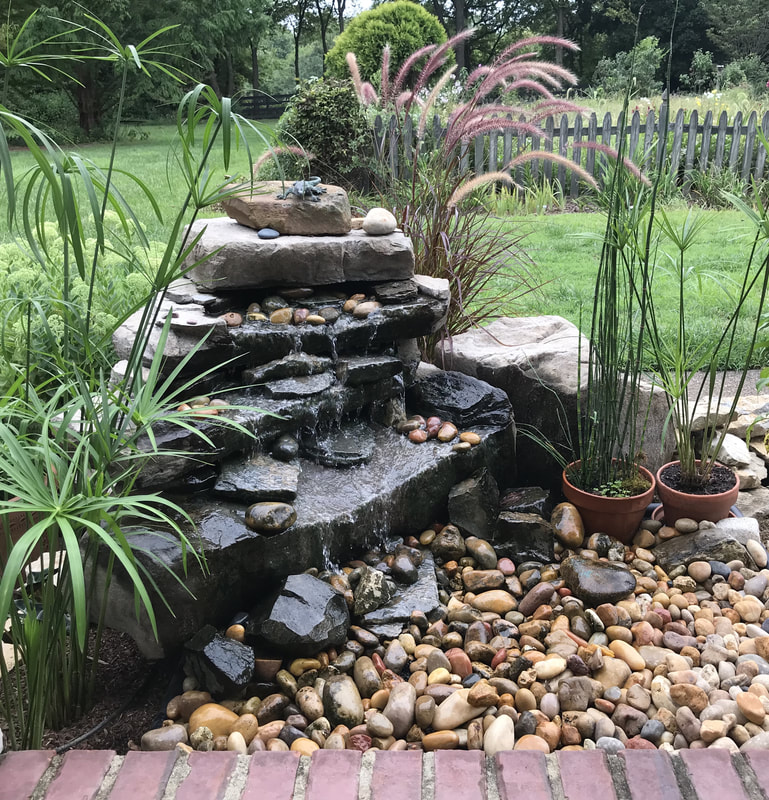
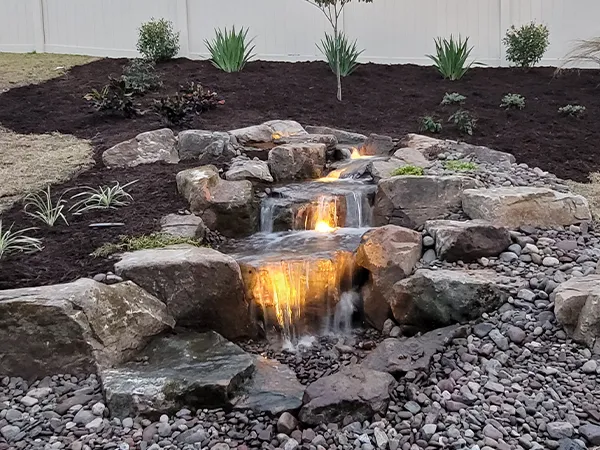
A pondless waterfall is exactly what it sounds like: the visual and auditory drama of a waterfall, without a standing pond at the base. Water cascades over natural stone and disappears into a gravel-filled underground reservoir, where a pump recirculates it back to the top. The reservoir is covered by rock and can be walked on.
| PROS Lower maintenance than a full pond. No standing water means no algae blooms, no mosquito habitat, and no fish to care for. Safer for households with young children. Lower weekly time investment. Excellent visual impact for the cost. |
| CONS You do not get the reflective quality or wildlife draw of a full pond. Water evaporation requires periodic top-offs. The underground reservoir still needs occasional cleaning, typically once a year. |
Cincinnati reality: Pondless waterfalls are the most practical water feature choice for most Cincinnati homeowners. They winterize simply — the pump is removed, the reservoir drains, and freeze-thaw cycles do not damage the system. The clay soil that causes problems for other underground installations is a non-issue here because the reservoir structure handles the load. Cost range: roughly $6,000 to $18,000 depending on size and stone quality.
2. Bubbling Boulders & Basalt Columns
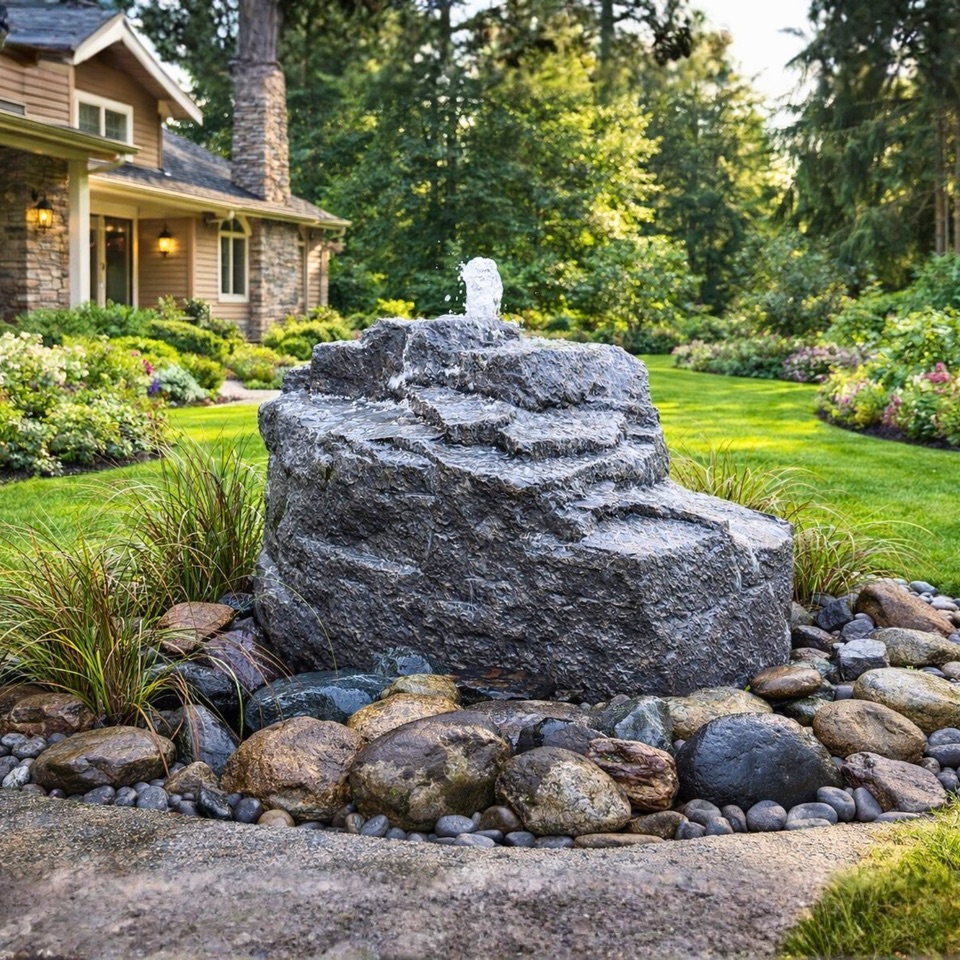
A bubbling boulder is a drilled natural stone — typically a large fieldstone or granite boulder — through which water is pumped to emerge at the top and run down the sides, draining into a small gravel-filled reservoir basin below. Basalt columns work identically but use tall, columnar volcanic stone, available as singles or grouped arrangements.
| PROS The most affordable entry point into professional water features, often installed for $1,500 to $3,000. Extremely low maintenance — the reservoir needs occasional cleaning, but there is almost no other upkeep. Compact footprint makes it perfect for smaller yards, patios, or garden focal points. Winterizes easily by removing the pump. |
| CONS Sound output is gentler than a full waterfall — it soothes, but it does not mask significant noise. Less visual drama than a multi-tier waterfall. Limited wildlife draw. |
Cincinnati reality: Bubbling boulders are especially popular in Hyde Park and Pleasant Ridge, where compact urban lots make larger features impractical but the desire for outdoor ambiance is just as strong. A single well-chosen boulder in a thoughtfully designed planting bed can be genuinely striking. This is also the ideal starting water feature for homeowners who are curious but cautious about maintenance commitment.
3. Traditional Ponds
A full pond — liner, filtration system, planted aquatic shelf, optional fish — is the most immersive water feature you can install. When designed well, it becomes the anchor of the entire landscape, creating a habitat that changes and grows year over year.
| PROS Nothing else creates the same ecological richness. Frogs, dragonflies, songbirds, and aquatic plants transform the feature into a living ecosystem. Full reflective surface. Can support fish (though Morning Light does not specialize in koi pond customization). Maximum visual drama and seasonal interest. |
| CONS Highest maintenance of any water feature type. Algae management, filter cleaning, leaf removal, plant division, and water quality monitoring are ongoing requirements. Requires professional winterization in Ohio. Standing water and fish require consistent attention. |
Cincinnati reality: Ohio’s freeze-thaw pattern is the central challenge for ponds. A pond must be deep enough — typically a minimum of 18 to 24 inches in the deepest zone — that fish can survive winter without the entire volume freezing solid. Managing a pond through Cincinnati’s wet spring also requires attention, as heavy rain events can overwhelm filtration and crash water quality quickly. Ponds are rewarding but deserve honest assessment of your time and interest.
4. Naturalistic Streams & Creek Features
A stream feature creates a flowing water channel through the landscape, typically connecting an upper source — often a waterfall or bubbling element — to a lower terminus, which may be a basin, a small pond, or a pondless reservoir. Stone-lined, planted on the margins, and designed to follow natural topographic logic.
| PROS Exceptional design flexibility — streams can traverse significant lengths of a property, work beautifully on sloped lots, and integrate with plantings in a way that looks genuinely naturalistic. Sound is distributed across the length of the feature rather than concentrated at one point. |
| CONS More expensive per square foot of landscape coverage. Requires skilled design to look natural rather than contrived. Leaves and debris accumulate in the channel and require clearing. |
Cincinnati reality: Loveland, Indian Hill, and Terrace Park homeowners — properties with wooded corridors and natural slope — get the most out of stream features because the setting already suggests moving water. A stream feature on a flat West Chester subdivision lot requires more design work to feel believable. Best suited to properties with topographic change or existing wooded character.
5. Fountains
Standalone fountain features — cast stone, precast concrete, or self-contained modular units — are distinct from the naturalistic water features above. They read as architectural or garden ornaments rather than landscape elements.
| PROS Strong formal design statement. Works well in front yards, courtyards, or as entry features. Wide range of styles and price points. |
| CONS Can feel generic when chosen from a catalog rather than custom-designed. Less sound presence than a waterfall. Requires winterization and typically draining completely in Ohio winters. |
Cincinnati-Specific Water Feature Considerations
Winterization — The Critical Factor
Ohio’s freeze-thaw cycles are the most important factor in water feature design and material selection. Systems must be designed from the start for winterization: pumps removed and stored, pipes drained, and where applicable, aerators or de-icers installed to maintain a small area of open water in ponds. Any feature installed without winterization protocols in mind will sustain damage within a few Ohio winters.
Do Water Features Attract Mosquitoes?
This is the most common concern homeowners raise — and the answer, for well-designed features, is no. Mosquitoes require standing, stagnant water to breed. Any feature with a recirculating pump creates enough water movement to prevent mosquito breeding. The only exception is if a pump fails and water sits still for a week or more. For full ponds, mosquito fish or other biological controls can be added as supplemental protection.
How Much Does a Water Feature Cost to Run?
Electricity cost is a legitimate question. A typical pondless waterfall pump running continuously draws between 80 and 200 watts — roughly $8 to $20 per month at Ohio electricity rates, depending on size. Many homeowners put pumps on timers, running the feature during the hours they actually use the yard, which reduces operating cost further.
Do I Need a Permit?
In most Cincinnati-area jurisdictions — Hamilton County, Butler County, Warren County — simple water features like pondless waterfalls and bubbling boulders do not require permits. Full ponds, particularly those that alter drainage patterns or exceed certain size thresholds, may require review. Morning Light handles permit coordination as part of every project.
Frequently Asked Questions
Q: What is the easiest water feature to maintain?
A bubbling boulder or basalt column. The reservoir needs cleaning once a season. The pump is winterized by simply removing it. There is nothing else to manage.
Q: How long does a professionally installed water feature last?
With quality materials and proper installation, 15 to 25 years is a realistic lifespan. Pumps are the most common component to replace, typically every 5 to 10 years. Stone and liner components outlast everything else.
Q: Can I have a water feature in a small Cincinnati backyard?
Absolutely. A bubbling boulder in a 10-by-10-foot garden bed is a completely realistic and beautiful installation. Water features are not inherently large. They are scaled to the property.
Q: What plants work well around water features in Cincinnati?
For the water’s edge: native blue flag iris, pickerelweed, and cardinal flower thrive in Cincinnati’s climate and look beautiful near moving water. For surrounding beds: ornamental grasses, ferns, and astilbe provide layered texture. Avoid plants that drop significant leaf debris directly into the water.
Q: Do water features add value to my home?
A professionally installed, well-maintained feature in good condition is generally an asset. A neglected or DIY feature can be a liability. Quality of design and installation matters more than the presence of the feature itself.
Working With Morning Light Landscaping
Morning Light designs and installs custom water features throughout the greater Cincinnati area — including pondless waterfalls, bubbling boulders, basalt column features, naturalistic streams, and multi-tier waterfall systems. We use exclusively natural stone and engineer every feature for Cincinnati’s specific climate conditions, including full winterization protocols.
We do not install features designed by others, and we do not customize koi ponds — this ensures that every feature we build is covered by our installation standards and can be properly maintained through our seasonal service visits.
If you have been thinking about adding a water feature to your Cincinnati property, a conversation costs nothing. Call us at 513-276-9895 or request a consultation at morninglightlandscaping.com/contact.