
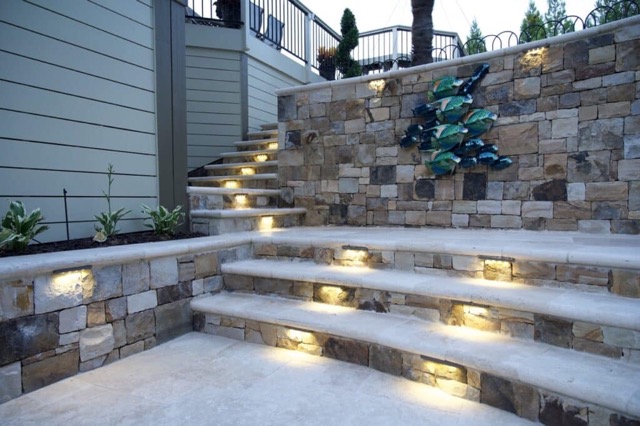
Landscape lighting doesn’t get nearly as much attention in residential landscaping conversations as patios or planting design, but for properties where it’s done well, it might be the single highest-impact visual upgrade per dollar spent. A property that looks fine in daylight looks genuinely impressive after dark with thoughtful lighting design. And beyond appearance, good lighting extends the practical use of an outdoor space by months – fall evenings in Cincinnati are long and beautiful, and a well-lit patio or garden is a space people actually want to be in after 7pm.
This guide covers the fundamentals of low-voltage landscape lighting: how it works, what kinds of effects are possible, what a realistic installation costs in the Cincinnati area, and what to know before you call a contractor.
How Low-Voltage Landscape Lighting Works
Modern residential landscape lighting runs on 12-volt systems rather than line-voltage (120V) wiring. This has two significant advantages: the installation doesn’t require an electrician (a licensed landscape lighting installer handles it), and the safety risk from accidental contact with the wire is dramatically lower than with line-voltage systems.
The components of a low-voltage system:
Transformer. The transformer is the control center – it steps down line voltage from your outdoor outlet to 12 volts and typically includes a timer or smart control that turns the lights on and off automatically. Modern transformers connect to WiFi and can be controlled from a phone, including scheduling based on astronomical sunset times so the lights adjust through the seasons.
Landscape wire. Low-voltage cable runs from the transformer through the landscape, typically buried 3 to 6 inches underground in garden beds and lawn areas. The cable connects to each fixture along the run.
Fixtures. The variety of landscape light fixtures covers most effects you’d want: – Bullet or spot fixtures for uplighting trees, architectural features, or focal plantings – Path lights for walkways and garden edges – Well lights for flush-to-grade uplighting in lawn areas – Flood lights for washing walls or large plantings – Deck and step lights for integrated hardscape lighting – String lights for overhead or festive effects
LED light sources. All modern landscape lighting installations use LED lamps. LEDs consume a fraction of the power of the halogen fixtures they replaced, last dramatically longer (often 50,000 hours or more), and produce less heat. The switch to LED also changed color temperature options – you can choose warm white (2700-3000K, the most natural look for nighttime landscapes) or cooler white depending on the effect you want.
What Good Landscape Lighting Design Looks Like
Bad landscape lighting is not hard to find. Solar pathway lights lined up along both sides of a walkway, shining straight up into the eyes of anyone walking past, are the most common example. Or floodlights mounted on a house wall that turn the front yard into a lit parking lot rather than a landscape. This kind of lighting doesn’t enhance the property – it just makes it bright.
Good landscape lighting design works with the landscape rather than just illuminating it. The principles:
Layer the light. The most effective lighting designs use multiple fixture types and heights to create depth. A combination of up-lit trees, path lighting at ankle height, and accent spots on architectural features creates a composition that reads as designed rather than just bright.
Uplight trees. A mature tree properly up-lit from below is one of the most powerful effects in residential landscape lighting. The structure of the canopy, the texture of the bark, the movement of the leaves in wind – none of these are visible in daylight in the same way they are with uplighting from ground level at night. If a property has specimen trees worth showcasing, this is almost always worth doing.
Use fixtures the eye doesn’t see. The best installations make you notice the effect, not the hardware. Fixtures should be positioned so the light source itself isn’t directly visible from normal viewing angles. Glare from a visible bulb destroys the effect.
Use shadows. Shadows are part of lighting design, not a byproduct to minimize. A carefully placed fixture that throws the shadow of a plant across a wall is an intentional design element.
Don’t overlight. More lights is not better. A concentrated effect on a few focal points works better than uniform illumination of everything. Night landscapes should have shadows and contrast, not be lit like a parking garage.
What Landscape Lighting Costs in the Cincinnati Area
Cost depends on the number of fixtures, the quality of the equipment, and the complexity of the installation (amount of wire, conduit requirements, access to an outdoor power source).
Entry-level professional installation (8-12 fixtures, basic path and uplighting): $1,500 to $3,500. Covers a simple front or back yard with path lights and a few accent spots.
Mid-range installation (15-30 fixtures, designed composition): $3,500 to $7,500. This is where real landscape lighting design happens – multiple zones, uplighting on significant trees, hardscape integration, and a quality transformer with smart controls.
Comprehensive installation (30+ fixtures, full property): $7,500 to $20,000+. Full front and back yard coverage, premium fixtures, integrated hardscape lighting, and comprehensive control system.
The fixture quality spectrum is significant. Consumer-grade solar fixtures are not comparable to professional-grade low-voltage fixtures in light output, lifespan, or weather resistance. Solar fixtures that look fine in a store produce inadequate light in actual use, fail within a couple of seasons, and can’t be designed with the precision of a hardwired system. We don’t install solar fixtures – the quality gap is too significant.
Maintenance and Long-Term Ownership
Low-voltage LED systems require minimal ongoing maintenance. LED lamps last many years in normal use and don’t need routine replacement. Annual service visits from a lighting professional to check connections, adjust fixture positions as plantings grow, and inspect the transformer are worthwhile for keeping the system performing well.
Things that do require periodic attention:
- Fixture positions shift as plants grow. A spot that was ideally aimed at a young tree may need to be adjusted as the tree matures.
- Wire connections can corrode or loosen over time, causing fixtures to dim or fail. Annual inspection catches these before they become problems.
- Transformers have a lifespan of 10 to 15 years for quality units. When a transformer fails, the fixtures are often worth keeping with a new transformer rather than replacing the whole system.
Frequently Asked Questions About Landscape Lighting in Cincinnati
Can I add lighting to an existing landscape, or does it need to be done during installation?
Lighting can be added to any established landscape. We route wire through planting beds without disturbing mature plantings in most cases. Adding lighting to an existing landscape is one of the most common landscaping projects we do.
Does landscape lighting increase home value?
Curb appeal improvements generally do. A well-lit property photographs better (important for real estate listings), appears more polished to buyers, and contributes to the overall presentation. The direct return on investment varies – the more immediate value is the enjoyment of the property while you live there.
How long does a landscape lighting installation take?
Most residential landscape lighting projects take one day for the installation. Larger properties or complex systems may take two days. The transformer typically needs an outdoor outlet – if one isn’t in an appropriate location, we coordinate with an electrician to add one before the lighting installation.
Do smart lighting controls really make a difference?
For most homeowners, yes. A smart transformer that adjusts the on/off schedule automatically throughout the year based on sunset times, can be controlled from a phone, and can be dimmed or zoned is genuinely more useful than a manual timer. The cost difference from standard to smart control is modest relative to the overall project cost.
What happens to landscape lighting in a severe storm?
Low-voltage wiring is designed to handle weather. Fixtures can be knocked or shifted by falling branches – this is the most common post-storm issue. A seasonal inspection after significant storms and after winter catches fixture displacement or damage. The system is not fragile, but it’s not entirely immune to physical damage from severe weather.
Morning Light Landscaping designs and installs landscape lighting throughout Hamilton County, Clermont County, and the surrounding Cincinnati area. Contact us to schedule a consultation for your property.