
A lot of homeowners think about landscape lighting as a single purchase, a string of path lights from the hardware store stuck into the mulch along the front walk. Done well, it’s actually closer to a design layer that changes how a whole property reads at night, highlights the hardscape and plantings you’ve already invested in, and makes the yard genuinely safer to move through after dark. Done poorly, it’s a handful of mismatched fixtures that are either too dim to matter or bright enough to feel like a parking lot.
What’s Actually Worth Lighting
Trees and the Front of the House
Uplighting a mature tree or the architectural features of a home’s facade, columns, stone, an interesting roofline, is usually the single highest-impact thing you can do. It’s also what most people picture when they imagine a well-lit property at night, even if they can’t name why a particular house looks finished and another one looks flat.
Paths and Steps
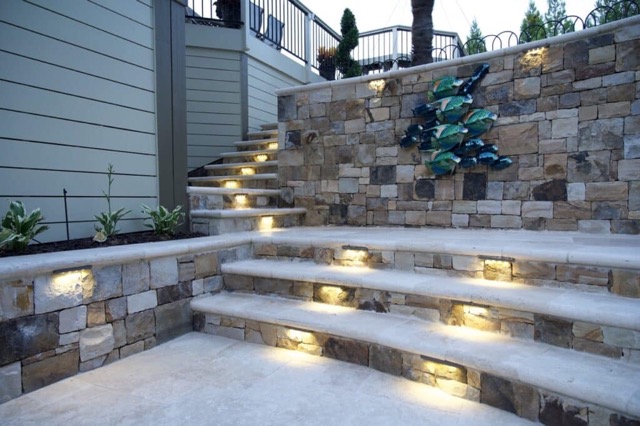
This is the safety layer, not just the decorative one. Steps, grade changes, and the edges of a walkway are where people actually trip after dark, and lighting them properly matters more than almost anything else on this list, especially for guests who don’t know the property.
Hardscape You’ve Already Built
A paver patio or a retaining wall that cost real money to install deserves to actually be visible at night. Small fixtures recessed into wall caps or step risers, or set low along a patio’s planting beds, extend the usable hours of a space you already paid to build.
What to Skip
Not everything needs a fixture. Lighting every single shrub or lining an entire driveway edge to edge usually creates visual clutter instead of a cohesive look. A good lighting design has intentional dark space between the highlighted elements, the same way good photography has shadow as well as light.
LED vs. Older Halogen Systems
Most new installations are LED now, and for good reason. LED fixtures run a fraction of the electricity cost of halogen, the bulbs last on the order of years rather than a season or two, and they run cooler, which matters for anything mounted near plantings or mulch. Older halogen systems still in the ground on a lot of established properties can often be retrofitted with LED bulbs or fixtures rather than replacing the whole system, which is worth asking about before assuming a full teardown is necessary.
Timers and Dusk-to-Dawn Sensors
Nobody wants to manually flip a switch every evening, and most systems today don’t require it. A photocell sensor turns lights on automatically at dusk, and a timer or smart controller can cut certain zones off at a set hour, say midnight, while keeping security-focused fixtures running until dawn. This is also where zoning matters: being able to run the front walk lighting all night for safety while the backyard accent lighting shuts off at 11 saves on electricity without leaving anything unsafe in the dark.
What It Actually Costs to Run
This is the question we get asked the most, and the answer tends to surprise people in a good way. A typical residential LED landscape lighting system, even a dozen or more fixtures running several hours a night, usually adds somewhere in the range of $5 to $15 a month to an electric bill, depending on fixture count and wattage. That’s a large part of why LED has become the default. A comparable halogen system can run several times that for the same number of fixtures.
Adding Lighting After a Patio Is Already In
A lot of our lighting work isn’t on a brand new installation, it’s added onto a patio or landscape that’s already finished. This is completely doable, it just takes more care than lighting a blank site, since wiring has to be run without disturbing existing pavers, plant roots, or irrigation lines. Low-voltage wiring can usually be trenched in narrow runs along bed edges rather than cutting through a finished hardscape, which is one of the reasons it’s worth having a lighting designer walk the property rather than guessing at fixture placement from a sketch.
Designing for the Whole Property, Not Fixture by Fixture
The properties that end up looking the best at night are the ones where lighting was planned as a layer across the whole yard rather than bought a fixture at a time. That’s true whether it’s a new build or an addition to an established landscape, and it’s the same approach we use across our landscape lighting projects. You can see how this fits into a full backyard plan in our posts on paver patios and retaining walls, both of which benefit enormously from the right lighting once they’re built.
Start With a Walk-Through at Dusk
The best way to plan a lighting layout is to walk the property as it’s getting dark and talk through what actually draws the eye. Our design and build process includes that kind of walk-through before we recommend fixture placement or a budget. Reach out to our team to schedule one for your property.
Common Questions About Landscape Lighting in Cincinnati
How much does landscape lighting cost to install?
This varies widely based on fixture count and the complexity of the property, but most residential systems run from a few thousand dollars for a handful of fixtures to well over $10,000 for a full-property design with many zones. A site walk-through is the most reliable way to get an accurate estimate.
How much does it cost to run landscape lighting each month?
For a typical LED system, usually $5 to $15 a month in added electricity cost, even running a dozen or more fixtures for several hours a night. Older halogen systems cost substantially more to run for the same fixture count.
Can I add landscape lighting to a patio that’s already installed?
Yes. Low-voltage wiring can typically be trenched in narrow runs along bed edges and planting areas without disturbing existing pavers, though it does take more careful planning than lighting a site before anything is built.
Should I replace my old halogen lighting system?
Not always from scratch. In many cases, existing halogen fixtures can be retrofitted with LED bulbs or swapped for LED fixtures on the same wiring, which is worth evaluating before assuming the whole system needs to be replaced.
Do landscape lights need to run all night?
Not necessarily. Many systems are zoned so safety-focused lighting, like path and step lights, runs dusk to dawn, while accent lighting on trees or hardscape can be set on a timer to shut off at a certain hour to save on electricity.