
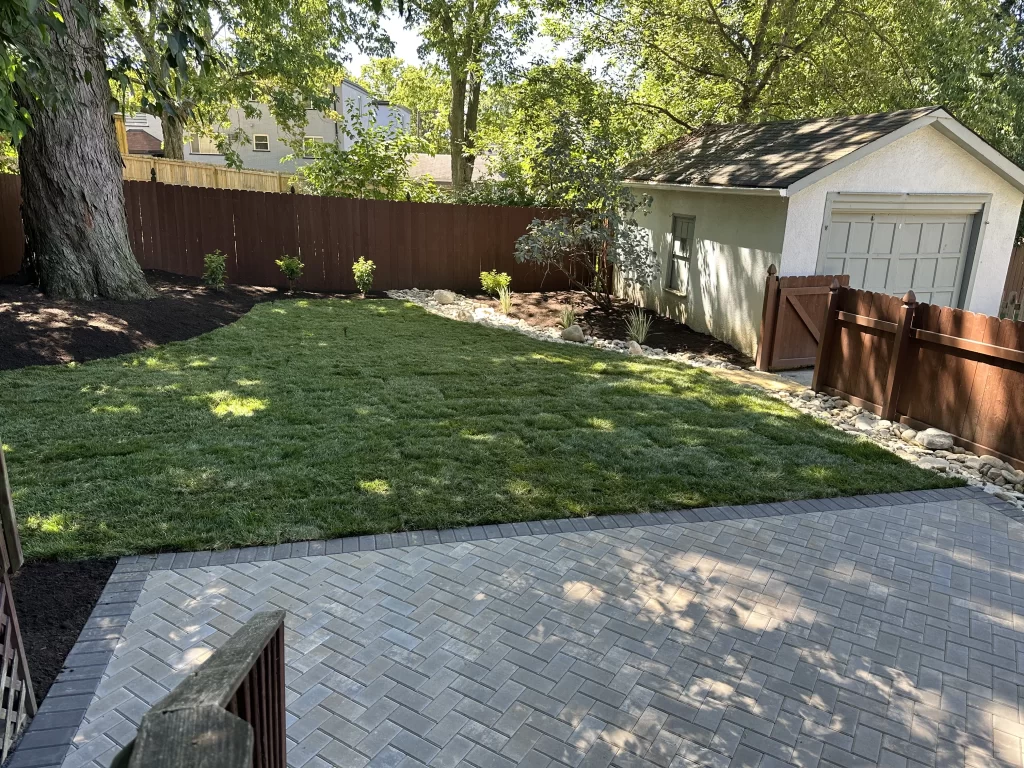
Mud tracked into the house, mosquitoes breeding in a corner of the lawn that never dries out, grass that dies back every spring in the same low spot. If any of that sounds familiar, you’re not alone, and it’s not something you have to live with. Cincinnati’s soil and weather combine in a way that makes drainage one of the most common problems we get called out for, and it’s almost never fixed with a bag of topsoil from the hardware store.
Why Cincinnati Yards Drain So Poorly
Most of the Greater Cincinnati and Northern Kentucky area sits on heavy clay subsoil. Clay particles are packed tightly together, so water can’t soak through the way it would in sandier or loamier soil. Instead, it sits on top or moves slowly across the surface until it finds the lowest point in your yard, which is usually right next to the foundation or in the middle of the lawn. Pair that with the sudden, heavy downpours this region gets through spring and summer, and you get yards that simply can’t absorb water fast enough. We see this constantly in Clermont County and Warren County, as well as across the river in Campbell County, and on the lower-lying lots around Loveland near the Little Miami.
The Most Common Causes of a Wet Yard
Poor Grading
If the ground around your home is flat, or worse, sloped slightly toward the foundation instead of away from it, water has nowhere to go but to sit and soak in right where you don’t want it.
Downspouts Dumping Next to the House
A huge amount of roof water, often hundreds of gallons during a single storm, gets dumped a foot or two from the foundation if downspouts aren’t extended. That water has to go somewhere, and it’s usually straight down next to your basement wall.
Compacted Clay With Nowhere to Drain
Years of foot traffic, mowing, and construction equipment during the original home build compact clay soil even further, reducing what little absorption it had to begin with.
Low Spots and Bowl Areas
Even a shallow depression in an otherwise flat lawn will collect water every time it rains, since water always finds the lowest available point.
Runoff From Neighboring Properties
On a sloped lot, water from an uphill neighbor’s yard can flow directly onto your property, which is a problem no amount of your own regrading will fully solve without a plan to intercept it.
Why This Isn’t Just a Lawn Problem
Standing water that sits for more than three or four days becomes a mosquito breeding ground. Chronic moisture against a foundation is one of the more common contributors to basement dampness and seepage. Grass sitting in saturated soil develops fungal issues and dies back, mulch beds rot, and any hardscape nearby, like a patio or walkway, can heave or settle unevenly as the soil beneath it repeatedly saturates and dries. In winter, that same standing water turns walkways into ice. It’s rarely just about the grass.
Real Fixes (Not Just Topsoil)
Regrading
Reshaping the yard so it falls away from the house at a consistent slope, generally a minimum of about a quarter inch of drop per foot of distance, is often the single most effective fix, and it’s one that prevents problems rather than just managing them after the fact.
French Drains
A french drain is a perforated pipe wrapped in fabric and buried in a gravel-filled trench. It intercepts water moving through the soil below the surface and redirects it to a safe outlet point, rather than letting it travel toward your foundation or pool in the lawn.
Channel and Trench Drains
These sit at the surface, usually along a patio or driveway edge, and catch sheet water before it ever reaches the house. They’re especially useful anywhere hardscape meets a slope.
Downspout Extensions
Running solid buried pipe from each downspout out to a safe discharge point, well away from the foundation, is one of the simplest and least expensive fixes, and it’s often the first thing worth addressing before anything more involved.
Dry Creek Beds
A stone-lined channel gives collected water a visible, attractive path to travel instead of cutting its own route across your lawn, and it works well paired with a french drain or downspout system.
Catch Basins
A catch basin collects water at a low point and routes it underground via pipe to wherever it can safely drain, which is often necessary when a yard has one persistent low spot that regrading alone can’t fully correct.
How to Know Which Solution You Actually Need
Most yards we evaluate need more than one of these fixes working together, not a single product applied everywhere. A proper site evaluation looks at where the water is actually coming from, how the yard is currently graded, and what the soil is doing before recommending anything. Be cautious of anyone who prescribes a french drain, or any single fix, without first walking the property during or right after a rain to see where the water is really moving. For broader site grading or erosion issues tied to a sloped yard, this often overlaps with the kind of work we cover in our guide to retaining wall installation, since the two problems frequently show up on the same property.
Stop Fighting Your Yard After Every Storm
A wet yard isn’t something you have to manage every season. With the right combination of grading, drainage, and in some cases hardscape, it’s a problem that gets solved once. You can see more about our approach on our drainage solutions page, or contact our team to schedule a site evaluation before the next storm rolls through.
Common Questions About Yard Drainage in Cincinnati
Why does my yard stay wet for days after it rains?
This is almost always a combination of heavy clay soil, which absorbs water slowly, and poor grading that gives the water nowhere to flow. Downspouts discharging too close to the house make the problem worse.
Will a french drain fix my soggy yard?
A french drain can solve subsurface water movement, but if the yard is also poorly graded or downspouts are contributing to the problem, a french drain alone usually won’t fully fix it. Most lasting solutions combine two or more fixes.
How much does yard drainage cost in Cincinnati?
Costs vary widely based on the scope, from a few hundred dollars for downspout extensions to several thousand for french drains, regrading, or catch basin systems. A site evaluation is the only reliable way to estimate cost for your specific yard.
Can bad yard drainage cause basement leaks?
Yes. Water that collects against a foundation instead of draining away is one of the more common contributors to basement moisture and seepage. Addressing grading and downspouts is often the first line of defense.
What’s the difference between a French drain and a channel drain?
A french drain is buried below grade and captures water moving through the soil. A channel drain sits at the surface, typically along hardscape, and captures water before it has a chance to soak in or run toward the house.