
A well-designed landscape is an investment — in your property’s value, your daily quality of life, and the health of the plants you’ve chosen to live with. But a landscape without maintenance is a landscape in slow decline. Shrubs grow shapeless. Weeds colonize mulch beds. Soil compacts. Plants that were thriving two years ago start to struggle.
In Cincinnati, that process happens fast. Southwest Ohio’s wet springs, heavy clay soils, humid summers, and freeze-thaw winters create more maintenance pressure than most homeowners expect — particularly in the first few years after a new installation. This guide gives you an honest, practical framework for what professional landscape maintenance actually involves, when things need to happen in our region, and how to think about the difference between doing it yourself and hiring a professional.
Why Cincinnati’s Climate Makes Maintenance Non-Optional
Greater Cincinnati sits in USDA Hardiness Zones 6a and 6b, with average annual precipitation of 41 inches — distributed relatively evenly across the year, with wet springs and occasional heavy summer storms. The dominant soil type throughout Hamilton, Warren, Butler, and Clermont counties is heavy clay: it holds moisture well for plants during dry summers, but it compacts easily under foot traffic, drains slowly after rain events, and undergoes significant volume change through freeze-thaw cycles.
These conditions mean that plant health and hardscape integrity require active management. Clay soil that is never amended and mulched becomes increasingly hostile to root development over time. Shrubs that are never properly pruned grow dense outer shells that shade their own interiors, reducing airflow and inviting disease. Mulch beds that are not refreshed annually become weed nurseries as the organic material breaks down and loses its suppression effectiveness.
The good news: professional maintenance — done on the right schedule with the right methods — addresses all of these factors simultaneously, and the cumulative benefit compounds over time. A landscape that has been properly maintained for three years looks markedly better and requires less intervention than a comparable landscape that has been neglected for the same period.
The Cincinnati Landscape Maintenance Calendar
Spring: The Most Important Maintenance Window
Spring maintenance in Cincinnati typically begins in late March to early April, depending on the year. This is the highest-value maintenance window of the season — what happens in spring sets the trajectory for the entire year.
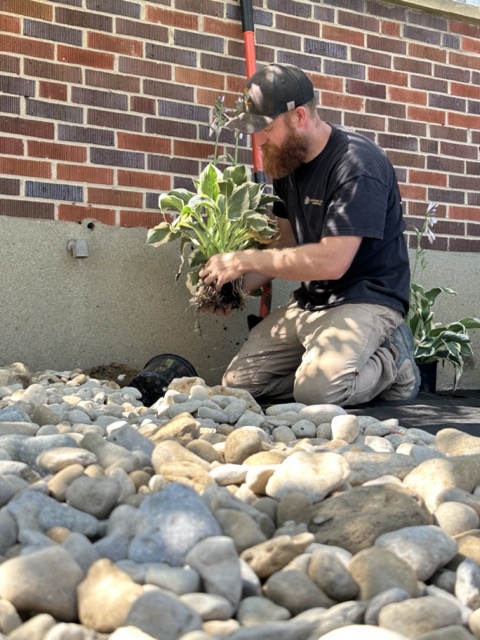
A proper spring cleanup includes thorough pruning of all shrubs and perennials, removal of winter debris, re-cutting of bed edges (what Morning Light calls Victorian-style re-edging — a clean, deep vertical cut that redefines the boundary between bed and lawn), application of pre-emergent weed control to reduce the season’s weed load before it starts, and fresh mulch application.
The mulch application in spring deserves its own emphasis. Fresh mulch — applied to the correct depth — insulates soil through Cincinnati’s variable spring temperatures, retains moisture as the season warms, suppresses emerging weeds, and feeds the soil as it breaks down over the season. Morning Light uses premium triple-shredded dark hardwood mulch for most applications, which decomposes slowly and integrates into the soil in a way that benefits plant health rather than creating a nutrient-depleted surface layer.
Summer: Weed Pressure, Heat Stress & Pruning of Spent Blooms
Cincinnati summers are warm and humid — ideal conditions for both garden plants and weeds. Summer maintenance focuses on weed control in beds, removal of spent blooms and awkward growth, monitoring for pest and disease pressure, and keeping the overall appearance clean and intentional.
Japanese beetles arrive in Cincinnati typically in late June and peak through July. They damage a wide range of ornamental plants — roses, linden trees, crape myrtles, and many others. Professional maintenance includes proactive monitoring and targeted treatment when thresholds are reached, preventing the kind of widespread defoliation that weakens plants heading into fall.
Bagworms are another significant summer threat in this region — specifically for arborvitae, juniper, and spruce. They are most effectively treated in late May to mid-June when larvae are small. Catching them early is a function of having trained eyes on the landscape regularly.
Fall: Prepare for Winter Without Over-Cutting
Fall is when well-intentioned homeowners often make their biggest maintenance mistake: cutting everything down. In Cincinnati, the better approach is selective. Some perennials benefit from fall cutting — hostas, for example, should be cut back after frost as their foliage collapses and can harbor disease. But ornamental grasses, coneflowers, black-eyed Susans, and many native perennials provide winter structure, wildlife habitat, and visual interest if left standing — and cutting them in fall rather than late winter removes that benefit without a corresponding payoff.
Fall is also an excellent time for light shrub pruning to remove any dead or crossing branches, fall fertilization of lawns (if applicable), a final round of weed control, and light leaf cleanup that prevents suffocating mulch beds under heavy leaf load.
Key Maintenance Practices — Done Right vs. Done Wrong
Mulching: The 2-to-3-Inch Rule
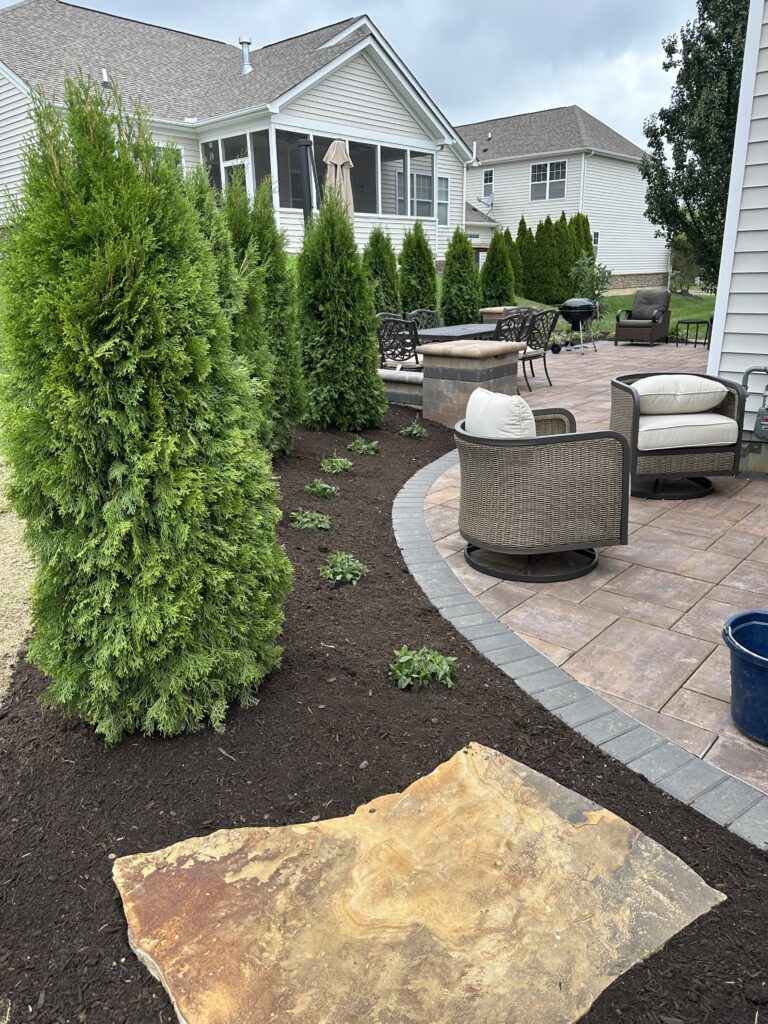
The most common mulching mistake in greater Cincinnati is application depth. Too thin — under an inch — and mulch provides no real weed suppression or moisture retention. Too thick — the notorious “mulch volcano” piled 6 inches deep around tree trunks — and you create moisture retention at the crown, bark decay, and conditions that invite pests and disease. The correct depth is 2 to 3 inches across all bed areas, tapering to zero within a few inches of any trunk or stem.
Dyed mulch is popular but offers no soil benefit. Triple-shredded natural hardwood breaks down over the season, feeding the soil as it decomposes, and holds its color reasonably well through Cincinnati’s summer. Pine straw is an excellent alternative for certain planting styles and stays in place well on slopes.
Pruning: Hand Pruning vs. Shearing
There is a fundamental difference between hand pruning — carefully removing individual branches from the interior of a shrub to improve structure, airflow, and light penetration — and shearing, which uses power hedgers to create a uniform exterior shape. Morning Light exclusively uses hand pruning methods.
Shearing produces plants that look tidy at a distance but creates increasingly dense outer shells over time that shade out interior growth. The result, after several years of shearing, is a plant with a green exterior shell and a dead interior — structurally unhealthy, prone to disease, and incapable of recovering its natural form. Hand pruning, done correctly, maintains the natural growth habit of the plant, improves its health, and makes it look intentional without looking clipped.
Fertilization in Clay Soil
Cincinnati’s clay-heavy soils are actually nutrient-rich compared to sandy soils — the challenge is not nutrient poverty but compaction and pH. Morning Light uses organic-based fertilizer formulations that improve soil biology over time rather than forcing short-term green growth. A soil test is the most valuable tool for understanding what your specific landscape needs — pH imbalances in Ohio clay can lock up available nutrients even when the nutrients themselves are present.
The Questions Homeowners Ask Most
When should I prune my hydrangeas in Cincinnati?
It depends entirely on the type. Panicle hydrangeas (Limelight, Bobo, Incrediball) bloom on new wood — prune them in early spring, late March to early April. Bigleaf hydrangeas (the classic mopheads and lacecaps) bloom on old wood — prune only immediately after they finish blooming, or you remove next year’s buds. This single confusion causes more unnecessary hydrangea non-blooming in Cincinnati than anything else.
How thick should my mulch be?
Two to three inches, consistently applied, tapering to zero at plant bases and tree trunks. Reapply annually in spring.
Should I leave leaves on my garden beds over winter?
A light leaf layer on planting beds — not so heavy that it mats down — provides some insulation and feeds the soil as it decomposes. The problem is when leaves mat into a suffocating wet layer that keeps soil soggy, invites mold, and smothers early spring growth. Remove heavy accumulations; a scattered light layer is fine.
Why are my shrubs declining after several years of looking fine?
The most common causes in Cincinnati are: compacted soil that has never been remediated; chronic over-shearing that has created structural decline inside the plant; mulch applied too heavily around the base over multiple years; and root damage from lawn care equipment or construction activity. A professional assessment can usually identify the cause and, depending on the severity, develop a recovery plan.
Should I use landscape fabric?
In most cases, no. Landscape fabric prevents weeds initially but degrades over several years, becoming a trap for weed seeds and debris that are harder to manage than a clean mulch bed. Professional-grade woven fabric has limited appropriate uses — primarily around large stones or in specific drainage applications — but it is not a substitute for mulch in standard planting beds.
Do you offer mowing?
Morning Light’s maintenance services focus on the planted landscape — beds, shrubs, trees, perennials, edging, mulching, fertilization, and water feature care. We do not offer mowing. If you need both services, we can recommend reputable lawn care providers in our service area.
DIY vs. Professional Maintenance — An Honest Take
Some landscape maintenance is genuinely well-suited to DIY: watering, deadheading, light weeding in manageable beds, and basic debris removal. These tasks require no specialized knowledge and the stakes of doing them imperfectly are low.
Other tasks carry higher stakes for error: pruning at the wrong time can eliminate a season’s blooms or permanently disfigure a plant’s structure; over-mulching around tree bases is a slow form of damage that compounds over years; incorrect pre-emergent timing can mean weed control that misses its window entirely. These are the areas where professional expertise pays for itself.
The honest calculation is this: professional landscape maintenance by a company that genuinely understands horticulture — not a mow-and-blow operation but a team with the knowledge to identify problems, time treatments correctly, and prune for long-term plant health — will produce a landscape that looks and performs better than almost any homeowner’s self-managed equivalent, at a cost that most homeowners find reasonable relative to the value of the investment being protected.
Working With Morning Light Landscaping
Morning Light’s landscape maintenance service operates on a seasonal visit model — spring, summer, and fall — with each visit designed around what the landscape actually needs at that point in the year, not a generic checklist. We hand-prune rather than shear, use organic-based fertilization, apply pre-emergent weed prevention on the correct Cincinnati timeline, and maintain the same standard of care visit to visit, year over year.
For clients who also have water features, those are serviced as part of our maintenance visits — keeping everything functioning and looking right without requiring separate scheduling.
If your Cincinnati-area landscape would benefit from professional care — whether it’s a recently installed Morning Light design or an existing landscape you want to bring up to a higher standard — we are glad to come take a look. Call 513-276-9895 or reach us at morninglightlandscaping.com/contact.